Role
Solo Full-Stack Engineer
Year
2026
Status
Completed
Overview
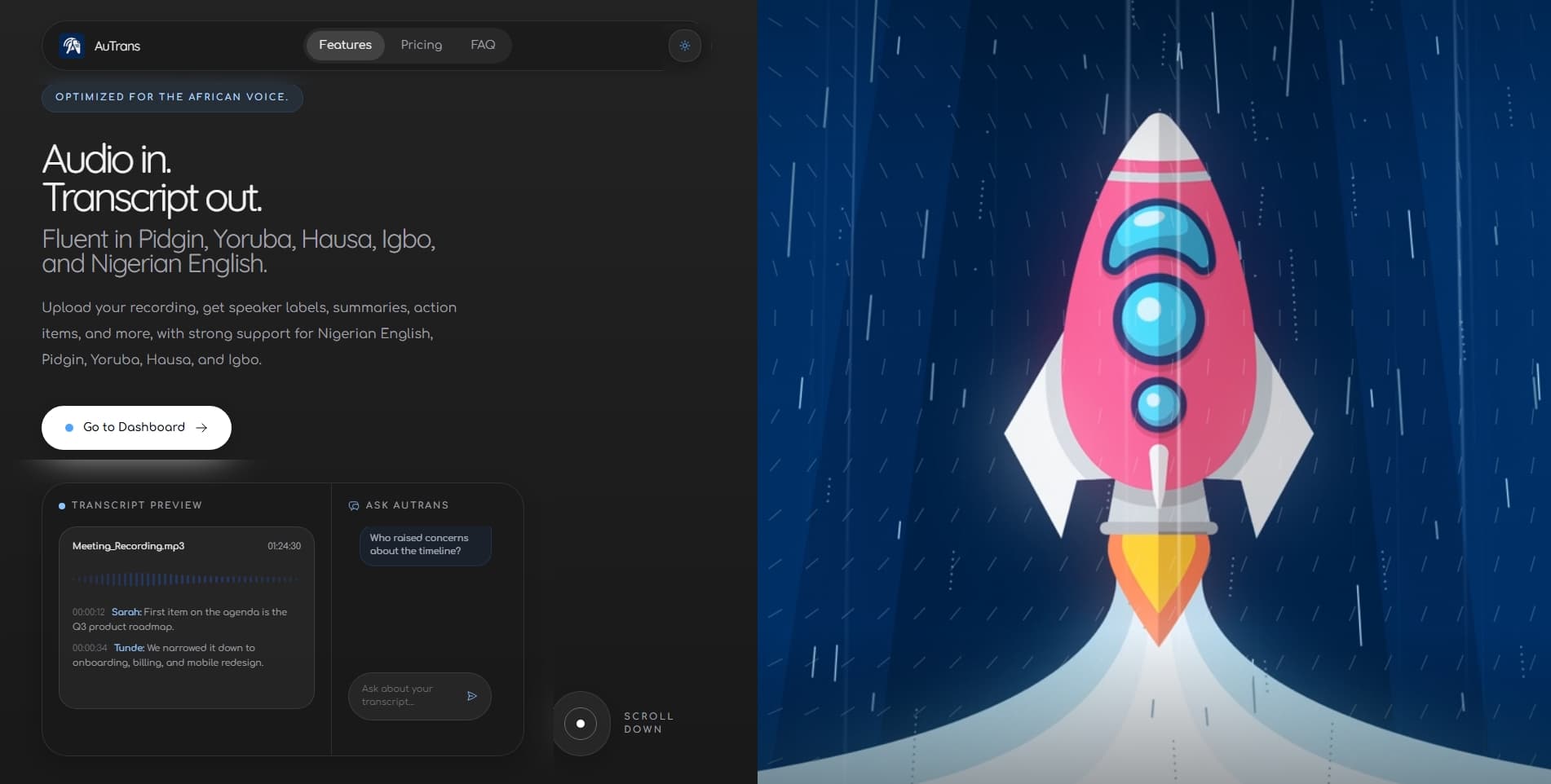
Mainstream transcription tools collapse on African audio — Pidgin gets mangled into broken English, Yoruba/Hausa/Igbo are unsupported, and code-switching mid-sentence guarantees failure. Anyone working with African audio had no option but to type transcripts by hand. AuTrans is a transcription platform that handles Nigerian English, Pidgin, Yoruba, Hausa, and Igbo as first-class African languages, including code-switching. Upload a recording or capture in-browser and get back a searchable transcript with speaker labels, summary, action items, and a chat interface to ask questions about the audio. Built solo as a product for African audio workflows, with a strong focus on reliability, language coverage, and search-friendly content.
The Problem
Mainstream transcription tools — Otter, Rev, Descript, Whisper — collapse on African audio. Pidgin gets mangled into broken English. Yoruba, Hausa, and Igbo are unsupported. Code-switching mid-sentence — how millions of Africans actually talk — is a guaranteed failure mode. The result is that anyone working with African audio (journalists, podcasters, founders, researchers, pastors, content creators) had no real option but to type transcripts by hand. AuTrans is the alternative built from the ground up for that audience.
Screenshots
Challenges
Off-the-shelf transcription drops sharply on long African audio — accuracy decays, code-switching collapses, and entire sentences come back unusable. The market gap is real but the technical bar to fill it is high.
Shipping a credible product across five African languages, multiple use-cases, and a content surface big enough to rank for transcription queries — solo, in one sprint, without an army of writers or engineers.
A CPU-heavy audio toolchain on Windows hits a known compiler bug that makes the dev loop painful. Iteration slows to a crawl exactly when iteration matters most.
Solutions
Built a dedicated transcription engine in Rust hosted on Pxxl that processes long recordings reliably end-to-end, with consistent quality across the full duration and first-class treatment of Pidgin, Yoruba, Hausa, Igbo, and Nigerian English including code-switching.
Built the SEO surface as data-driven page templates over a typed sitemap and MDX content layer — new languages, use-cases, personas, and competitor comparisons ship as configuration, not code. One sprint produced dozens of indexable pages.
Applied targeted per-crate optimization overrides on just the hot-path dependencies in the Rust engine — keeping iteration fast on Windows without bloating dev builds or sacrificing release performance.
Key Highlights
Custom Transcription Engine: A dedicated Rust audio engine — hosted on Pxxl — turns long recordings into finished transcripts in minutes with consistent quality across the full duration, not just the first 30 seconds.
African Languages, First-Class: Pidgin, Yoruba, Hausa, Igbo, and Nigerian English are primary languages with full code-switching support, not bolt-ons after the fact.
Full Intelligence Layer: Every transcript ships with speaker diarization, summary, action items, and a chat-with-transcript interface — built on Gemini — not just raw text.
Programmatic SEO Surface: A typed sitemap and MDX content layer span languages, use-cases, personas, and competitor comparisons — designed to rank from day one, scaling as configuration, not as more code.
Scale & Scope
~35,000
Lines of Code
59
API Endpoints
39+
Pages / Routes
5
African Languages
Solo
Team Size
Outcome
Soft-launched 2026-05-10 at autrans.online with the full transcription, intelligence, and subscription stack live — Pidgin, Yoruba, Hausa, Igbo, and Nigerian English supported on day one. Currently in post-launch hardening ahead of the public push.