Role
Full-Stack Engineer & AI Architect
Year
2026
Tech Stack
9 Technologies
Status
Completed
Overview
Most AI research tools are a black box: one prompt in, one wall of text out, and no way to know whether the model read a real source or made it up. A Pack is built the opposite way. Give it a question and a pack of eight specialized AI wolves plans the work, searches the web in parallel, challenges every weak claim, and produces a cited research brief — every move streaming live on a canvas, every claim carrying a receipt, and the total cost shown before a single cent is spent. Built for the Qwen Cloud Global AI Hackathon — all inference runs on Qwen models via Alibaba Cloud.
The Problem
AI research tools give you a spinner and a wall of text. You have no idea if the model read a real source, made something up, or hallucinated a citation. There is no transparency, no cost visibility before it runs, and no way to audit what happened. A Pack is the opposite: every action is visible, attributable, and auditable before and after it runs.
Screenshots
Demo
Challenges
Building a reliable multi-agent orchestration system where eight distinct wolf roles coordinate without deadlocking, stalling, or silently dropping work mid-hunt.
Streaming a live event canvas to the browser while keeping the event log append-only, replayable, and tamper-evident — the UI had to be a pure function of the stream, not a separate state machine.
Implementing a hard spend cap (Boundary) that warns, downgrades model tiers, and halts with a checkpoint before a single overspend cent is committed — all without disrupting the running hunt.
Solutions
Built a Supervisor loop in Python/FastAPI that drives each hunt: assigns a dense per-hunt sequence number, validates every event against a frozen JSON schema, and commits to Postgres in one transaction — no dual-write window.
Transactional outbox pattern: Postgres is the single source of truth; a relay tails committed events and republishes to Redis Streams. The Rust/Axum gateway tails Redis and fans out to browser WebSockets. Frontend reducer drops seq <= lastSeq so duplicates are no-ops.
Boundary system: cost is estimated via /rehearse before approval; during the hunt the Supervisor tracks spend in real time, downgrades from max → plus → flash under pressure, then halts with a checkpoint the user can resume or abort.
Key Highlights
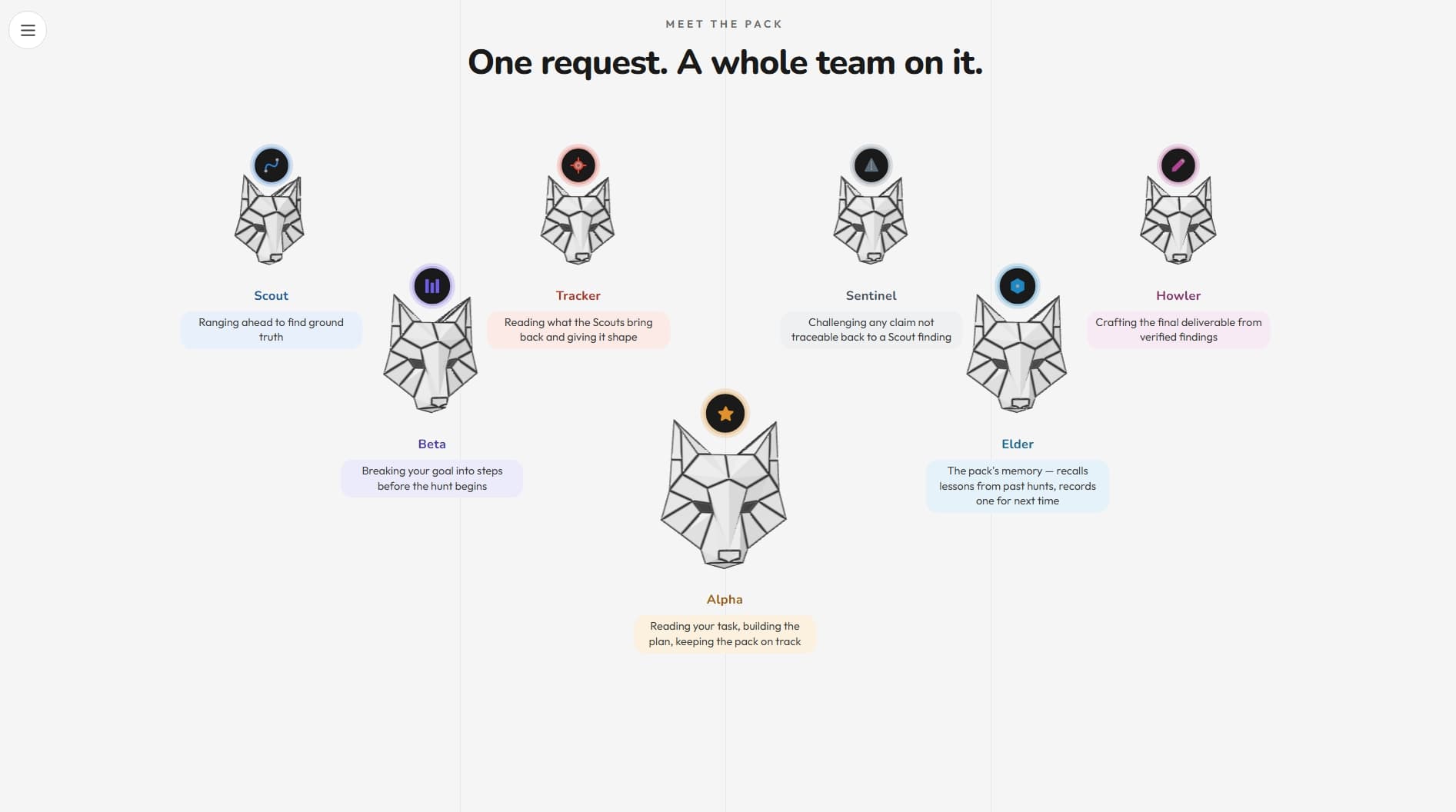
Eight wolf roles, one hunt: Alpha (orchestrator), Beta (planner), Scouts (parallel web researchers), Tracker (analyst), Sentinel (critic that drops unsourced claims), Howler (writer), Elder (memory), Warden (field medic that reroutes faulted wolves).
Every claim carries a receipt — who found it, which source, whether the Sentinel challenged it. challenged_kept claims survived on evidence. Nothing happens off-screen.
Flight Recorder: the full event log is replayable. Every decision the pack made can be audited step by step after the hunt completes.
Elder memory system: lessons from past hunts are stored, readable, editable, and vetoable by the user before they influence the next run.
Benchmark mode: the pack runs head-to-head against a lone agent on the same task, scored — proving the multi-agent approach outperforms a single model at scale.
Scale & Scope
8
Wolf Roles
14+
API Endpoints
Real-time
Event Stream
Qwen
Inference
Technology Stack
Outcome
Shipped for the Qwen Cloud Global AI Hackathon — live at 47.237.4.147 on Alibaba Cloud ECS with real Qwen inference, completed hunts you can open immediately, and claim receipts showing the Sentinel's full audit trail.